

How to Test a Relay With a Multimeter: A Detailed Guide A multimeter tests a relay in two ways. First, set it to ohms (Ω) mode and measure the coil …
Featured
Be the first
to know.
Sign up for Digilent's monthly newsletter for product updates and more!
Recent Articles
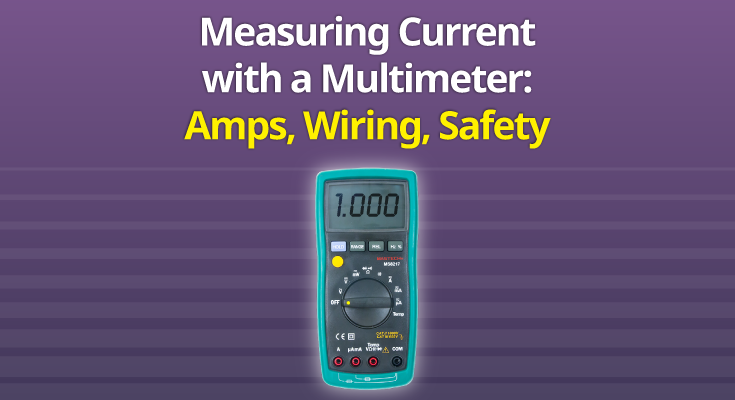
To measure current with a multimeter, you break the circuit and insert the meter in series. Set the meter to A (amps) or mA, plug the red probe into the …
There’s a particular kind of project that a lot of engineering students want to attempt but never quite start. Building a processor is high on that list. It sounds like …
Hello readers, Oscar Fonseca here, Product Manager at Emerson, working closely with our NI and Digilent academic customers. I’m excited to announce the release of LabVIEW WaveForms Toolkit 2.0. One …
At OTH Regensburg, Prof. Dr.-Ing. Heiko Unold has spent years finding new ways to connect engineering theory with hands-on experimentation. By integrating the Analog Discovery platform across multiple courses, he …
Field-programmable gate arrays (FPGAs) are digital devices. They can’t read a voltage directly. To bring an analog signal into an FPGA, you need an ADC, short for analog-to-digital converter. You …
Popular Posts
Howdy from Ft. Worth, Texas, where another NI Connect came to a fabulous end last week. Digilent was proud to share new tech, provide live demonstrations of our fan favorites, and generally …
TLDR on Digilent’s new ADP2440 and ADP2450 What it is USB‑based mixed signal oscilloscopes for modern prototyping, research, and validation. Four analog channels, sixteen digital I/O, integrated arbitrary waveform generator, …
High-Speed, High-Bandwidth Mixed Signal Oscilloscopes for Modern Engineering Workflows The Analog Discovery Pro 2400 Series expands Digilent’s professional test and measurement lineup with a pair of USB-based mixed signal oscilloscopes designed for …
NI is excited to unveil the USRP B206mini-i, the newest addition to the Ettus USRP family. This compact, credit card-sized software-defined radio (SDR) delivers powerful RF capabilities in a low-cost, portable …
In modern engineering education, project-based learning (PBL) is transforming classrooms from theory-heavy lectures to hands-on, practical experiences. The Analog Discovery Studio Max (ADS Max) and its companion, the Canvas Max, …
At Digilent, we understand the evolving needs of engineering education. That’s why we’re thrilled to introduce the Analog Discovery Studio Max (ADS Max), a versatile and comprehensive electronics laboratory solution …
A small post for Digilent’s largest products. All three rebranded NI VirtualBenches are now sold by Digilent and supported by WaveForms on Windows Fastest and highest bandwidth mixed signal …
Let’s talk about clocking. It’s crucial to the functionality of FPGA boards and digital design in general, as all synchronous logic depends on clocks. In this article, we’ll define some …
Shifting Academic Focus In late June, Digilent attended the American Society of Engineering Education (ASEE) Annual Conference. We’re no strangers to the event, and have been proud to show off …
Brandon K. provides a quick rundown on the nuances of notation.
Today we will go over a brief overview on FPGAs!
Ever find yourself in the situation where you’re asking yourself “I have my device plugged in, so why isn’t it working?”. A common issue is the USB cable – the …
At this point in reading the blog and going through the learn material, you might realize that there is a lot of FPGA code. It doesn’t look like C, it doesn’t look like Java…what is it?