

Hello readers, Oscar Fonseca here, product manager at Emerson, working closely with our NI and Digilent academic customers. In this blog, I’m going to compare the NI ELVIS III and the Digilent Analog Discovery Studio Max (ADS Max).
As someone who works closely with educators and academic labs, I am often asked a familiar set of questions about our ADS Max platform:
- Should I use ELVIS III, or move to the ADS Max?
- Are the two platforms compatible?
- Can ADS Max replace ELVIS III?
- Is the same ecosystem of ELVIS III top boards available for ADS Max?
Now that ELVIS III has reached end of life and institutions are planning their next steps I intend to help you understand how ADS Max compares to ELVIS III, where it is a strong replacement, and where other Digilent or NI solutions may be a better fit.
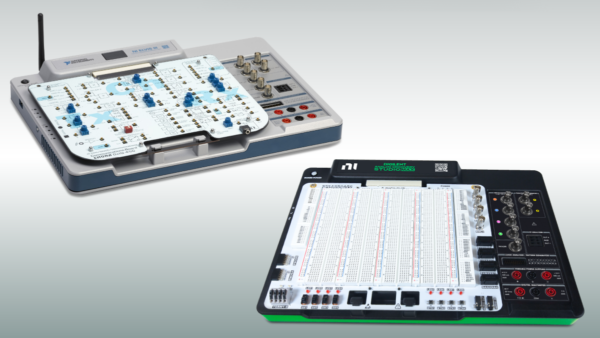
What is the Analog Discovery Studio Max?
The Analog Discovery Studio Max is a streamlined, instrumentation-focused platform designed for engineering labs. It preserves the familiar breadboard-equipped form factor and core instrumentation I/O that many instructors relied on with ELVIS, while intentionally focusing the platform on instrumentation by removing embedded control elements that not all courses require.
For engineering laboratories, this means that ADS Max reduces setup time, lowers system cost, and allows students to focus on understanding signals and measurements rather than managing embedded targets and software layers.
ADS Max and ELVIS III: A High-Level Comparison
ADS Max retains the core instrumentation experience that made ELVIS popular in electronics labs, including high quality analog and digital measurement instruments and a bench friendly form factor. This includes oscilloscope and waveform generator channels, a DMM, an IV analyzer, and variable power supplies.
Where the two platforms differ is in scope and intent: the ELVIS III was designed as a broad teaching platform that combined instrumentation with Real-Time and FPGA-based control (typically used for deterministic control, robotics, and advanced embedded systems). The ADS Max, by contrast, focuses squarely on instrumentation and does not include a Real-Time or FPGA target, and its connector for Canvas Max add-on boards does not expose analog input or output channels, unlike the ELVIS III PCI expansion connector.
It’s important to note that while the expansion connectors share a similar physical form factor, the ADS Max pinout is much simpler. As a result, most existing ELVIS III top boards are not compatible with ADS Max. You can find the pinout in each device’s manual.
Ecosystem Support
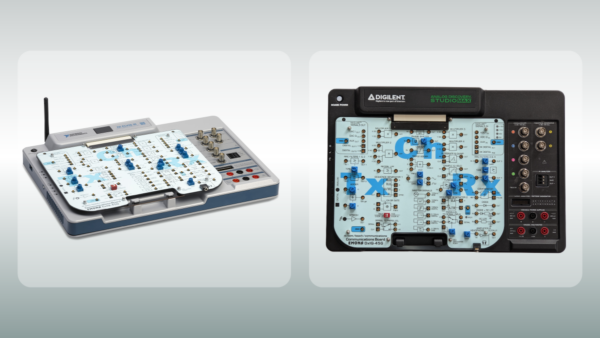
Although the hardware platform has evolved and new expansion boards are required, the ecosystem many educators rely on remains available, and we are working to expand it. Communications labs can continue to rely on our partner EMONA with ADS Max, including the same EMONA courses that have been used historically available for the ELVIS platform.
Biomedical and chemistry labs are also supported through our continued partnership with iWorx, providing sensors and software that enable the ADS Max to serve as a foundation for these application areas. It empowers biomedical engineering students to progress from basic physiological measurements to designing and validating their own devices, all within the same familiar breadboard‑based environment.
Common Use Cases and Recommended Platforms
So, here are my recommendations based on your application:
- Electronics and digital labs are an excellent fit for ADS Max, where its simplified instrumentation-first approach shines. Communications courses can pair ADS Max with EMONA boards to achieve the same learning objectives used previously with ELVIS.
- For biomedical and chemistry applications, ADS Max combined with iWorx sensor packages and software continues to meet curriculum needs.
- For robotics, mechatronics, and advanced control classes that truly require deterministic control or custom hardware acceleration, platforms such as the NI sbRIO or the Digilent FPGA-based solutions remain the recommended and supported choice for these applications.
- For sensor measurement and signal acquisition use cases, dedicated DAQ products such as NI myDAQ or NI mioDAQ are often a better fit for sensor‑based labs, helping students acquire raw signals and convert them into meaningful measurements such as temperature, strain, or pressure. When paired with NI FlexLogger, they form a powerful, low‑overhead workflow for data acquisition and analysis.
Software Experience
ADS Max uses Digilent WaveForms, a desktop application available on Windows, macOS, and Linux that includes an SDK to use it on Python® and C/C++.
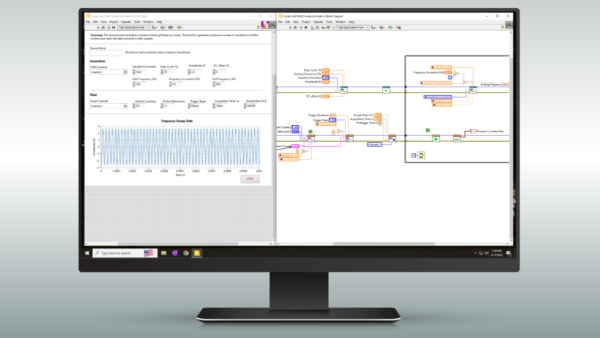
How about NI LabVIEW? Of course! For educators who use LabVIEW, ADS Max supports LabVIEW through the LabVIEW WaveForms Toolkit available from VI Package Manager, without requiring LabVIEW Real-Time or LabVIEW FPGA. Here is a tutorial. This significantly reduces software complexity compared to ELVIS III, while still allowing LabVIEW‑based workflows for labs that prefer them.
So, is ADS Max a Replacement for ELVIS III?
ADS Max is not a drop-in replacement for ELVIS III. Course materials and lab instructions will require updates. However, for most ELVIS III use cases focused on instrumentation and measurement, ADS Max represents a practical, modern and simplified replacement.
Conclusion
The NI ELVIS platform has played an important role in academic labs for many years. ADS Max builds on that legacy by focusing on how instrumentation is taught today: simpler setups, faster onboarding, and tools that keep students focused on learning.
I look forward to seeing how educators and students continue to create, experiment, and succeed with Analog Discovery Studio Max and the broader Digilent academic ecosystem.


If a teaching school lab has already invested heavily in NI ELVIS III systems and budgets are tight, is there a compelling reason to switch to the ADS Max beyond access to WaveForms? I think many schools would really appreciate it if Digilent made WaveForms compatible with ELVIS III. It seems like it wouldn’t be too difficult to adapt WaveForms to work with the ELVIS hardware, and that would make the transition much more attractive for existing labs.
Great question – and a fair point. If a lab is already well‑equipped with ELVIS III, it absolutely makes sense to keep using it since it’s a powerful platform. We appreciate the feedback on WaveForms compatibility and will take that suggestion into consideration as we plan future updates.