

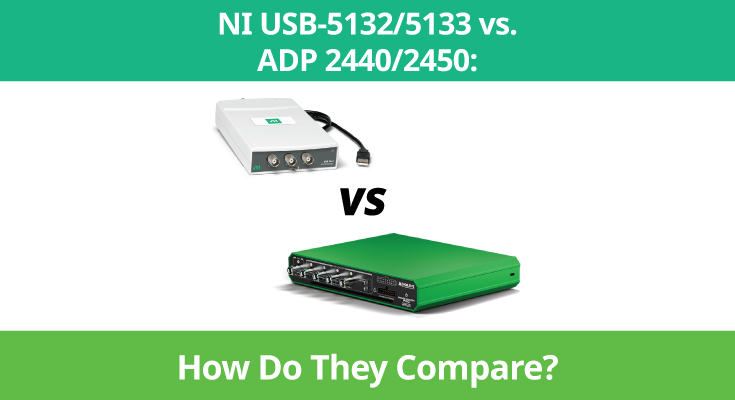
NI USB oscilloscopes have a strong track record. If your workflow specifically depends on NI‑SCOPE driver features, InstrumentStudio, or formal calibration services, then NI’s modular instruments are the right path. For most prototyping, research, and validation teams, the Analog …
Featured

Be the first
to know.
Sign up for Digilent's monthly newsletter for product updates and more!
Recent Articles
If you have ever pushed the bandwidth higher on an instrument and thought, “Why does this look worse now?” you are not alone. Many engineers run into this when they try to …
Digilent’s WaveForms software includes a small built-in FPGA utility, which is used to configure (program) the FPGA on supported Digilent boards directly from within WaveForms. If you’ve been around for …
The Question A user getting started with the Analog Discovery 3 (AD3) wanted to generate a waveform using the Arbitrary Waveform Generator while simultaneously sampling an analog input – both …
TLDR on Digilent’s new ADP2440 and ADP2450 What it is USB‑based mixed signal oscilloscopes for modern prototyping, research, and validation. Four analog channels, sixteen digital I/O, integrated arbitrary waveform generator, …
High-Speed, High-Bandwidth Mixed Signal Oscilloscopes for Modern Engineering Workflows The Analog Discovery Pro 2400 Series expands Digilent’s professional test and measurement lineup with a pair of USB-based mixed signal oscilloscopes designed for …
Popular Posts
TLDR on Digilent’s new ADP2440 and ADP2450 What it is USB‑based mixed signal oscilloscopes for modern prototyping, research, and validation. Four analog channels, sixteen digital I/O, integrated arbitrary waveform generator, …
High-Speed, High-Bandwidth Mixed Signal Oscilloscopes for Modern Engineering Workflows The Analog Discovery Pro 2400 Series expands Digilent’s professional test and measurement lineup with a pair of USB-based mixed signal oscilloscopes designed for …
NI is excited to unveil the USRP B206mini-i, the newest addition to the Ettus USRP family. This compact, credit card-sized software-defined radio (SDR) delivers powerful RF capabilities in a low-cost, portable …
In modern engineering education, project-based learning (PBL) is transforming classrooms from theory-heavy lectures to hands-on, practical experiences. The Analog Discovery Studio Max (ADS Max) and its companion, the Canvas Max, …
At Digilent, we understand the evolving needs of engineering education. That’s why we’re thrilled to introduce the Analog Discovery Studio Max (ADS Max), a versatile and comprehensive electronics laboratory solution …
A small post for Digilent’s largest products. All three rebranded NI VirtualBenches are now sold by Digilent and supported by WaveForms on Windows Fastest and highest bandwidth mixed signal …
Let’s talk about clocking. It’s crucial to the functionality of FPGA boards and digital design in general, as all synchronous logic depends on clocks. In this article, we’ll define some …
Shifting Academic Focus In late June, Digilent attended the American Society of Engineering Education (ASEE) Annual Conference. We’re no strangers to the event, and have been proud to show off …
Brandon K. provides a quick rundown on the nuances of notation.
Today we will go over a brief overview on FPGAs!
If you’ve been around electronics for a while, you’ve probably noticed that components like resistors, capacitors, zener diodes and inductors come in some odd values. Looking at the chart above, there seems to be no clear rationale behind the values, but there is a pattern. 47kΩ resistors and 22μF capacitors are everywhere, but not 40kΩ or 50kΩ resistors, or 20μF or 30μF capacitors. So what’s the deal? It all has to do with preferred numbers.
Ever find yourself in the situation where you’re asking yourself “I have my device plugged in, so why isn’t it working?”. A common issue is the USB cable – the …