

Hardware engineers don’t always stay in the lab. Sometimes they work from home, or they need to test equipment that cannot be brought into the laboratory. In those situations, a portable all-in-one measurement tool is ideal, as it combines several instruments and allows them to work everywhere.
Richard Oed
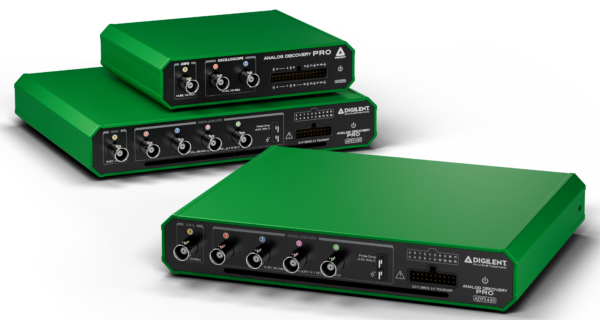
For hardware engineers—that is, those who design printed circuit boards, debug embedded systems, or analyze signals—working on the go is no longer the exception. It is part of their job. While it was long assumed that they had to be physically present in their test lab, the boundaries for mobile hardware development have now largely disappeared.
There are many reasons why engineers want or need to be mobile. One of them, and perhaps the most important, is working from home. Typical tasks here might include verifying circuit designs, debugging prototypes, or validating newly written algorithm on hardware.
Sometimes, the devices to be tested are so large that they cannot be carried to the laboratory for evaluation. Think, for example, of trains and locomotives or big industrial machines that can only be transported in disassembled form and require qualification measurements at their destination. This means that service or test engineers are dispatched to a customer site. And, in most cases, they prefer to bring their equipment with them, as this eliminates the need to first learn how to operate the customer’s tools.
Teams working partially from home or in the office also benefit from an all-in-one measurement solution with a unified user interface, where the configurations can be saved, as they can share their setup more easily. For business trips and trade fairs, engineers can prepare the setup in advance and simply pack their laptop and the tool into their backpack, and are immediately ready for operation at the fair or during customer demos.
What all these scenarios have in common is the fact that they benefit from a multi-function measurement device combined with a powerful software, as it is smaller than conventional laboratory instruments and less complicated to handle. In short, it is a complete lab in a single device.
Why is this more complex than writing software?
Hardware development has its specific set of challenges when it comes to equipment. A personal computer (PC) with the appropriate Integrated Development Environment (IDE) is sufficient for pure software design on general-purpose computers, including large server or mainframe systems with remote access. Creating embedded systems, be it software or hardware, is more demanding, as it requires dedicated tools, and the necessary tests and measurements are usually tied to a physical infrastructure: oscilloscopes, logic analyzers, power supplies, and signal generators occupy an entire workbench and are rarely transportable. If engineers want to be mobile with their lab equipment, they need a different approach: portable yet professional measurement instruments.
But the advantages of multi-function devices go far beyond portability. As all instruments in such devices use the same time base, they can therefore be synchronously triggered. This way, skew, and jitter, which will inevitably occur when triggering an oscilloscope and a logic analyzer from separate devices, can be avoided. As a result, engineers can easily relate, for example, a voltage drop to a starting SPI transfer.
Another benefit is the possibility to save all settings and scripts in a single project file, which can then effortlessly be reloaded later on. Moreover, spontaneous instrument swaps can be done without the need to alter the cabling. Probes stay where they are; only the instrument is changed in the software. No benchtop stack can offer that. And finally, test engineers don’t have to switch back and forth between the different graphical user interfaces from various manufacturers and their distinct operating concepts.
The ADP 2000 Series: Three Devices, One Principle
One might ask, is there a measurement tool whose hardware and software meet all these requirements? The answer is simply yes: it’s the Analog Discovery Pro 2000 series from Digilent. This series consists of three models that differ in bandwidth and resolution, and all follow the “complete lab in a pocket” concept. Table 1 lists the key features of the available versions.
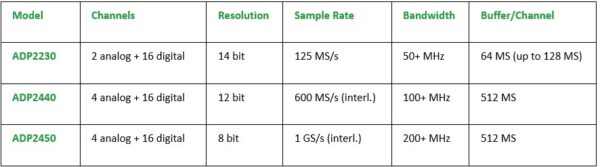
Table 1: Comparison of the three members in Digilent Analog Discovery Pro 2000 series.
The large acquisition buffers make it easy not only to catch rare or intermittent errors but also to correlate slow events to a fast signal. And it’s ideal to analyze protocols over longer sequences.
All models use USB 3.2 (5 Gbps) for fast streaming to the host computer, feature 16 configurable inputs/outputs (digital I/Os), are equipped with BNC connectors for analog functions, and have a rugged aluminum enclosure. If more channels are required, two devices can be synchronized via the BNC trigger terminals at the rear. The result is an 8-channel analog and 32-channel digital system with two arbitrary waveform generators. And when tests need to be performed in environments where a lab setup is not possible, the DIN rail mounting holes open up additional use cases in field automation and industrial continuous-duty deployments.
A Single Device Instead of a Rack
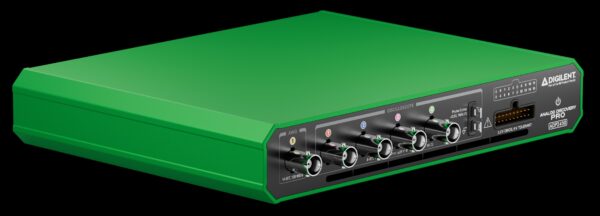
Each model in the ADP 2000 series replaces several stand-alone measurement tools. This includes an oscilloscope, an arbitrary waveform and a pattern generator, a programmable lab power supply, a voltmeter, and a data logger and script editor, as well as logic, protocol, network, impedance, and spectrum analyzers.
In short, instead of a “stack” of expensive individual devices that cost tens of thousands of dollars and take up an entire lab bench, the price of the ADP 2000 Series is significantly less, and it fits into a laptop bag.
However, even the best measurement hardware cannot unfold its full potential if the accompanying software and the graphical user interface aren’t up to the task. And that’s where Digilent’s free software application, WaveForms, enters the picture.
One Software for All Instruments
WaveForms connects to the Analog Discovery Pro 2000 series, as well as to the other measurement devices from Digilent’s Discovery line, through the USB port of the tool and is available for Microsoft Windows, macOS, and Linux. It provides a clear and intuitive access to all the various instruments of the ADP 2000 series and allows engineers to acquire, record, display, and analyze the obtained data sets, as well as to generate signals and digital patterns. Datasets can also be saved for later processing in a different environment or streamed in real-time.
Additionally, WaveForms can decode various protocols, such as SPI, I2C, I2S, UART, and CAN, as well as custom formats, directly in the software. This allows engineers to analyze the communication between different components in their system without the need for an external analyzer – again an important feature for working on the go.
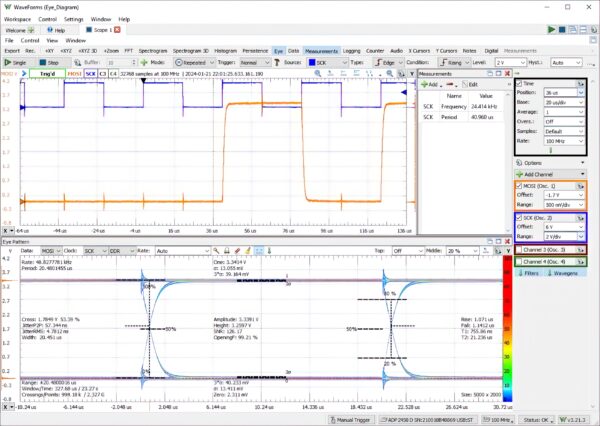
A key point is the ability to export the configuration of the entire project, either to import it anew later, or to share it with colleagues so they can use the same setup in their measurement campaign. Furthermore, the Software Development Kit (SDK) of WaveForms provides APIs (Application Programming Interfaces) for Python, C, and other languages. This enables full automation, for example, unattended overnight tests. The ADP 2000 series is also compatible with LabVIEW and the Digilent Toolbox add-on for MathWorks’ MATLAB. This allows the ADP series to be seamlessly integrated into existing environments.
Rail Vehicles as an Example
Every train is a highly complex, distributed real-time system with dozens of networked control units for train control, braking, doors, and passenger information systems. And as it certainly does not fit into a lab, engineers who test or commission its electronics must work directly in the vehicle, in the depot, or even along the tracks. This means that the measuring devices should be extremely portable.
All the various components are networked across multiple bus hierarchies. A Wire Train Bus (WTB) is used for communication between the cars within a consist. An MVB (Multifunction Vehicle Bus) is installed in a car or locomotive, and standard protocols such as CAN, SPI, I2C, or UART are used at the system or subsystem level. These are natively supported by WaveForms, which significantly simplifies testing and error detection.
All transmissions are affected by EMI or noise, which can be created by the catenary, connectors, or the data communication via automated digital couplers. They can generate voltage variations and transient voltages, and engineers must log the behavior of onboard electronics across different input voltages. The ADP 2000 series mixed-signal oscilloscopes allow for the simultaneous setting of the supply voltage, monitoring of signal integrity on the buses, and saving of the data as a raw input file for later audits.
Timing errors in serial communication between microcontrollers and peripherals are also a common issue. The logic analyzer and protocol decoder of the Analog Discovery Pro 2000 series can, for example, capture SPI transactions with precise timestamps and correlate events with firmware states.
This example illustrates the paradigm shift quite well: the lab is no longer tied to a room in a building. It belongs to the engineers and accompanies them wherever their job takes them. They can now work everywhere.


