
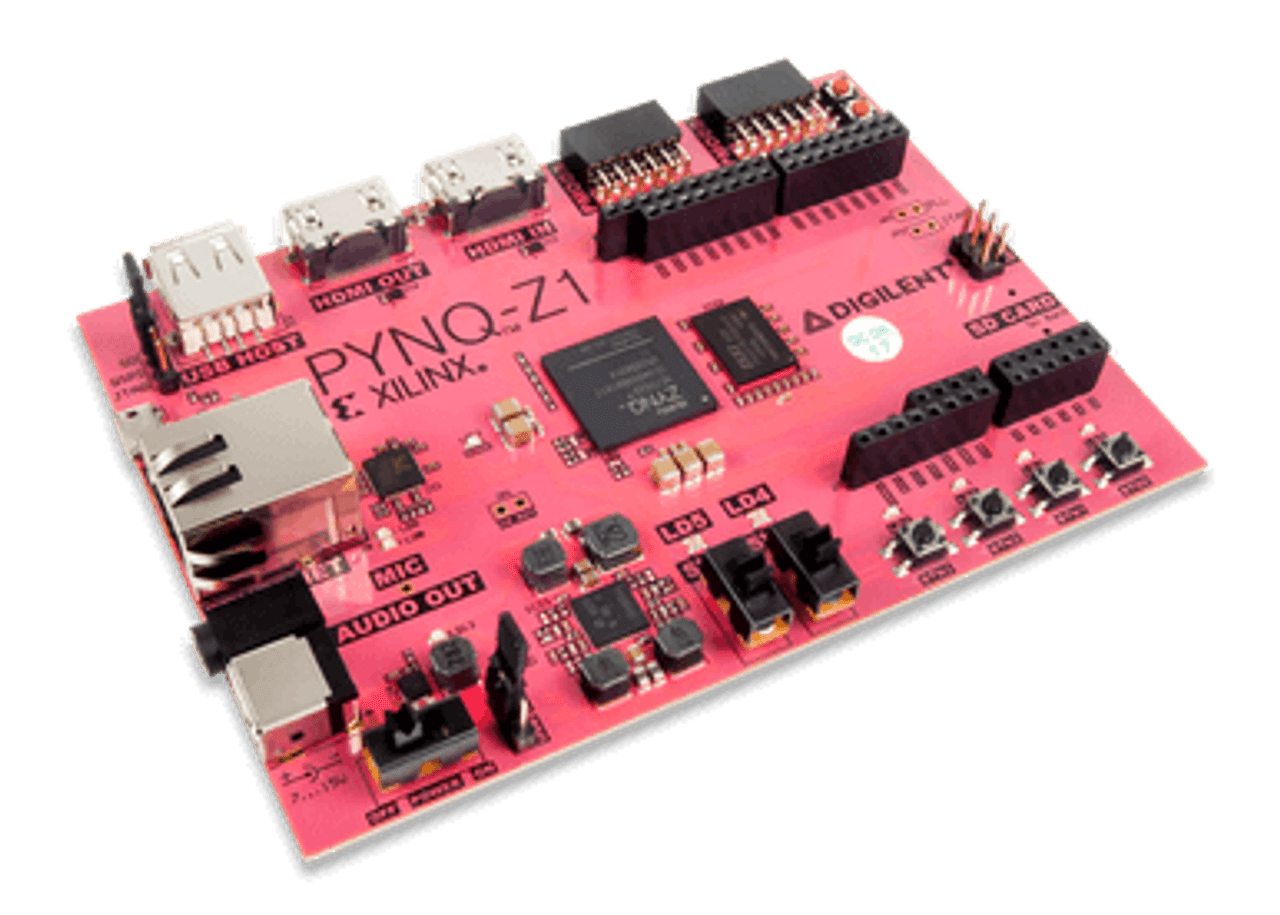
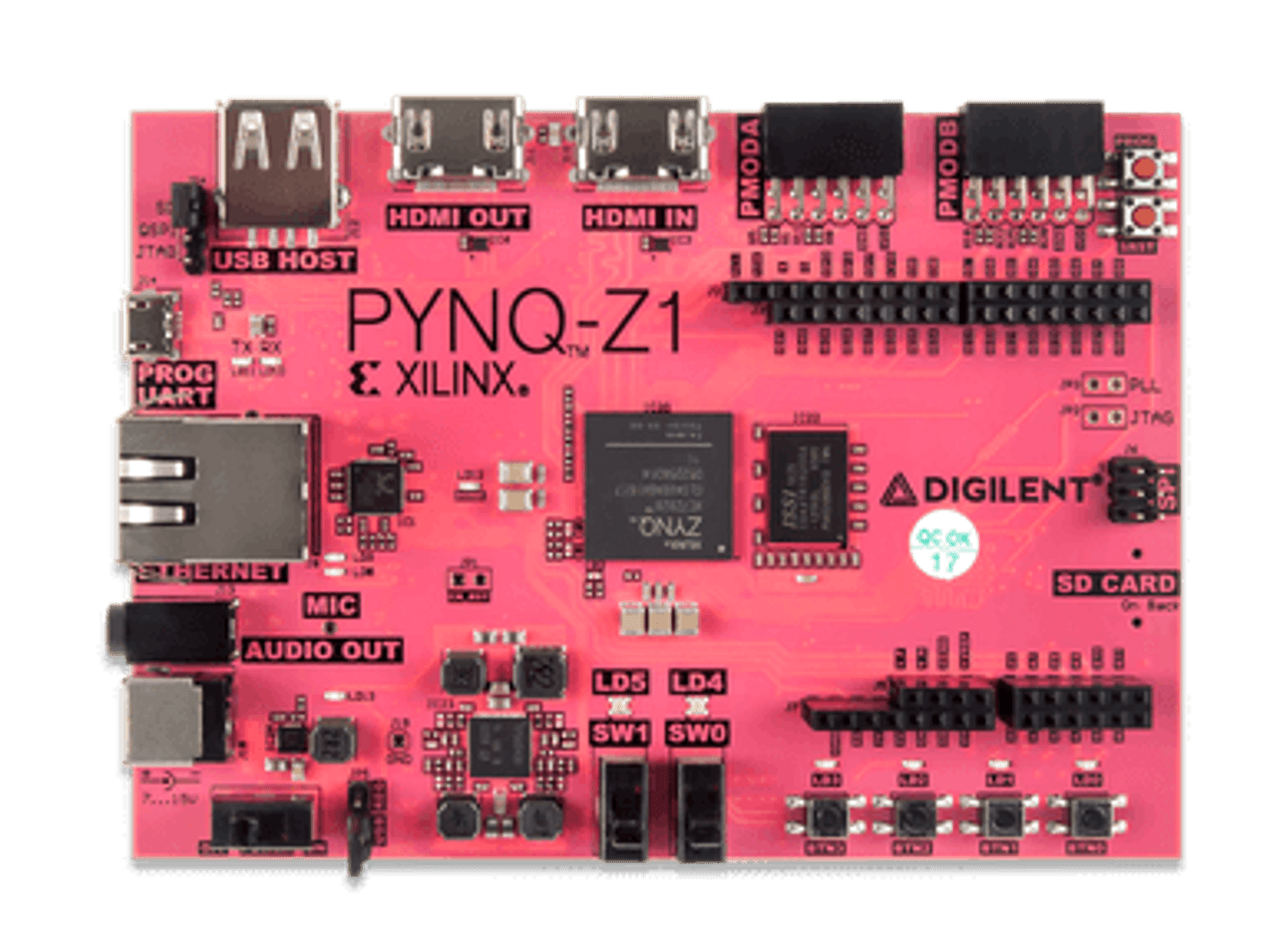


The PYNQ-Z1 board is designed to be used with the PYNQ open-source framework that enables embedded programmers to program the onboard SoC with Python. It is designed around the AMD Zynq®-7000 SoC, which combines the programmable logic of an FPGA with a dual-core ARM Cortex™-A9 processor.
Hardware-wise, the PYNQ-Z1 is flexible and ready-to-use. It is similar in form factor and features to Digilent's Arty Z7, featuring popular Arduino™ headers, Pmod ports, onboard I/O, HDMI in/out, audio out, and USB and Ethernet connectivity. This makes the PYNQ-Z1 a versatile and easily customizable SoC development platform for applications such as computer vision, industrial control, IoT, encryption, and embedded computing acceleration.
What really sets the PYNQ-Z1 apart is the PYNQ open-source framework. (See the Software tab for more details on the PYNQ framework.) The board can be booted from a microSD card containing PYNQ-Z1 boot image. The PYNQ-Z1 image can be downloaded for free and copied to a microSD card. See the Support Materials for additional information. You can also purchase a microSD with the image pre-loaded here.
For designers who want to extend the base system by contributing new hardware libraries, AMD Vivado Design Suite WebPACK edition tools are available free of cost.
For PYNQ projects and support, visit www.pynq.io.
-
SoC Features:
-
ZYNQ XC7Z020-1CLG400C
-
650MHz dual-core Cortex-A9 processor
-
DDR3 memory controller with 8 DMA channels and 4 high performance AXI3 slave ports
-
High-bandwidth peripheral controllers: 1G Ethernet, USB 2.0, SDIO
-
Low-bandwidth peripheral controller: SPI, UART, CAN, I2C
-
Programmable from JTAG, Quad-SPI flash, and microSD card
-
Programmable logic equivalent to Artix-7 FPGA
-
13,300 logic slices, each with four 6-input LUTs and 8 flip-flops
-
630 KB of fast block RAM
-
4 clock management tiles, each with a phase-locked loop (PLL) and mixed-mode clock manager (MMCM)
-
220 DSP slices
-
On-chip analog-to-digital converter (XADC)
-
-
- Memory:
- 512 MB DDR3 with 16-bit bus @ 525 MHz (1050 MT/s)
- 16MB Quad-SPI Flash with factory programmed globally unique identifier (48-bit EUI-48/64™ compatible).
- MicroSD slot
- Power:
- Powered from USB or any 7V-15V source (see recommended products)
- USB and Ethernet:
- USB-JTAG Programming circuitry
- USB-UART bridge
- USB OTG PHY (supports host only)
- Gigabit Ethernet PHY
- Audio and Video:
- Electret microphone with pulse density modulated (PDM) output
- 3.5mm mono audio output jack, pulse-width modulated (PWM) format
- HDMI sink port (input)
- HDMI source port (output)
-
Switches, push-buttons, and LEDs:
-
4 push-buttons
-
2 slide switches
-
4 LEDs
-
2 RGB LEDs
-
-
Expansion Connectors:
-
Two standard Pmod ports
-
16 Total FPGA I/O
-
-
Arduino/chipKIT Shield connector
-
49 Total FPGA I/O
-
6 Single-ended 0-3.3V Analog inputs to XADC
-
4 Differential 0-1.0V Analog inputs to XADC
- Product Compliance:
- HTC: 8471500150
- ECCN: 5A992.c
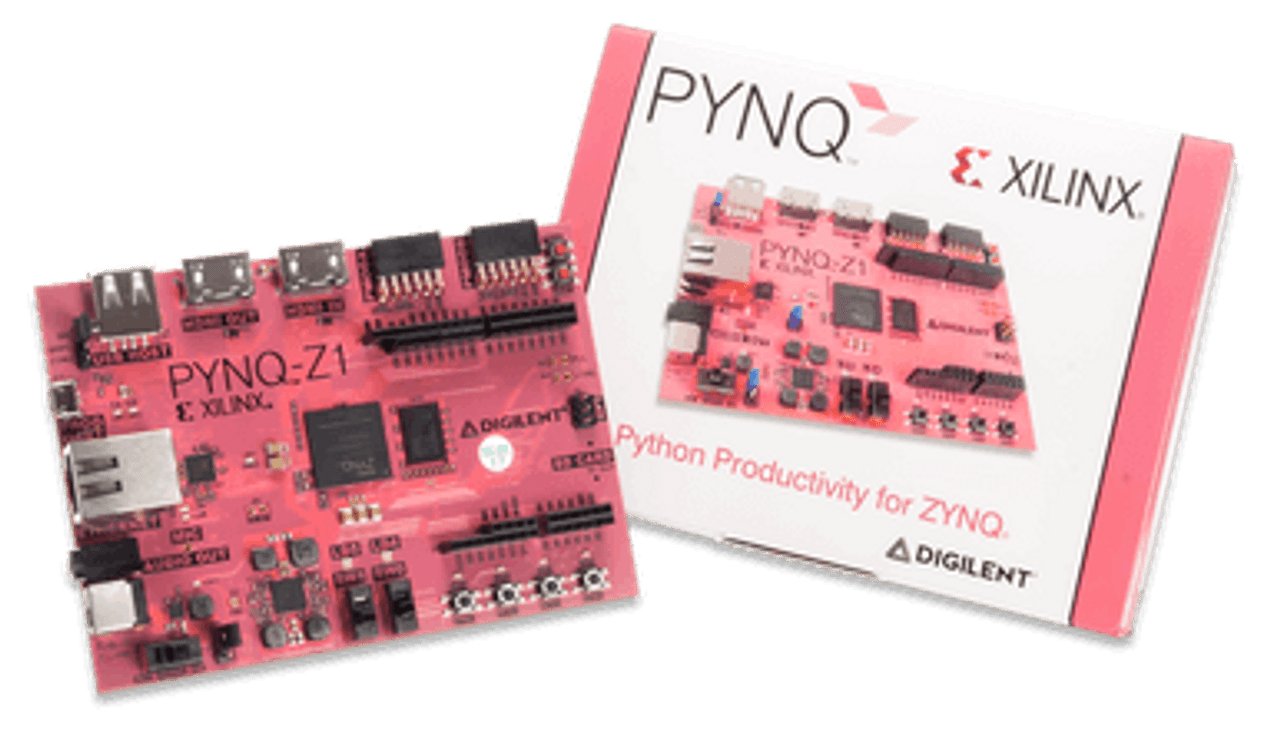
- PYNQ-Z1 development board
The board does not include a power supply, USB cable, Ethernet cable, or microSD card as these are tools interchangeable between many other products.
With the PYNQ-Z1 open-source framework, embedded developers and engineers can program the Zynq-7000 SoC using Python and test the code directly on the PYNQ-Z1. The programmable logic circuits are imported as hardware libraries and programmed through their APIs in essentially the same way that the software libraries are imported and programmed.
Additionally, the software running on the ARM Cortex-A9 processor will include:
- Web server hosting the Jupyter Notebooks design environment
- The IPython kernel and packages
- Linux
- Base hardware library and API for the FPGA
Visit the Support Materials tab for additional details, or to download the PYNQ-Z1 boot image.
Note: AMD software tools are not available for download in some countries. Prior to purchasing the PYNQ-Z1, please check the supporting software's availability, as it is required for the board's use.
Quickly find what you need to get started and reduce mean time to blink.
All product support including documentation, projects, and the Digilent Forum can be accessed through the product resource center.
Resource Center


