

The Cmod, or Carrier Module, family of products is designed to offer quick, simple, and flexible integration of an FPGA into circuit design, prototyping, and learning/hobby projects.
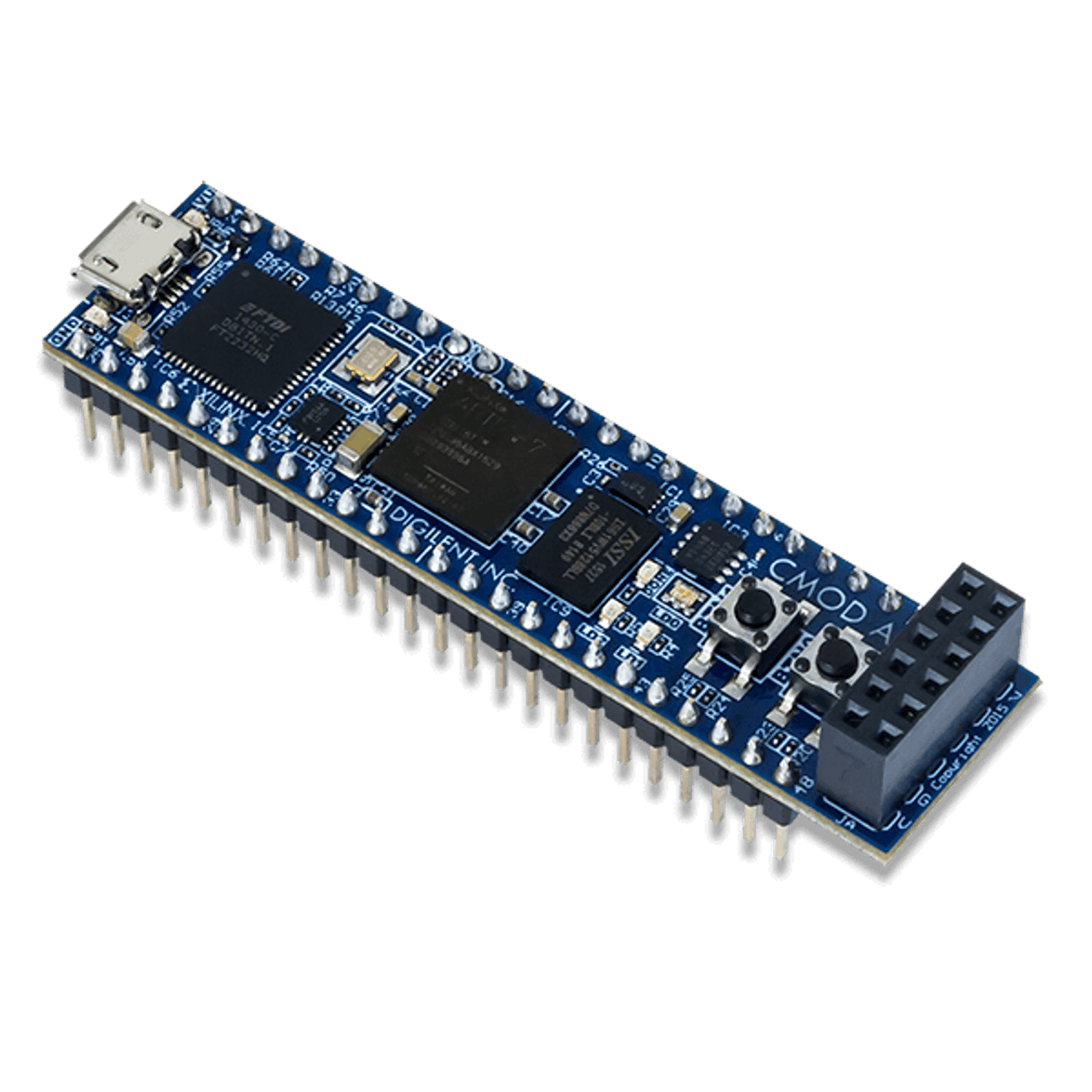
The Digilent Cmod A7 is a small, 48-pin DIP form factor board built around a AMD® Artix®-7 FPGA that brings FPGA power and prototyping to a solderless breadboard.
The board includes a Quad-SPI flash for programming, as well as a USB-JTAG programming circuit and USB-UART bridge. The Cmod A7 also features a clock source, Pmod port, and onboard I/O with LEDs and pushbuttons. There are 44 FPGA I/O signals that are routed to 100-mil-spaced through-hole pins, making the Cmod A7 compatible with solderless breadboards. This form factor makes the Cmod A7 a great option for flexible and affordable prototyping, or learning FPGA and digital logic circuits. At just .7" by 2.75", it can also be loaded in a standard socket and used in embedded systems.
The Artix®-7 FPGA on the Cmod A7 provides the highest performance-per-watt fabric, transceiver line rates, DSP processing, and AMS integration for a cost-optimized FPGA. With the MicroBlaze Soft Processor Core from AMD, you can create embedded applications with a variety of peripherals, memory, and interfaces.
If your design does not require the transceiver lines or higher-performance of the Artix®-7 FPGA, we recommend the more affordable Cmod S7, featuring a Spartan®-7 FPGA.
Guides and demos are available to help users get started quickly with the Cmod A7. These can be found through the Support Materials tab.
-
System Features
-
512KB SRAM with an 8-bit bus and 8ns access times
-
4MB Quad-SPI Flash
-
USB-JTAG Programming Circuitry
-
Powered from USB or external 3.3-5.5V supply connected to DIP pins
-
-
System Connectivity
-
USB-UART bridge
-
-
Interaction and Sensory Devices
-
2 LEDs
-
1 RGB LED
-
2 Push Buttons
-
-
Expansion Connectors
-
48-pin DIP connector with 44 Digital I/O and 2 Analog inputs (0-3.3V)
-
One Pmod connector with 8 Digital I/O
- Product Compliance:
- HTC: 8473301180
- ECCN: EAR99
- Cmod A7 Module
- Custom Digilent cardboard box with protective foam
To create and modify designs for your Cmod A7, you can use AMD's Vivado Design Suite. Vivado is a software designed for the synthesis and analysis of HDL designs. Both variants of the Cmod A7 are supported by the free WebPACK edition of the Vivado Design Suite.
If you are using the MicroBlaze Soft Processor Core from AMD, you can make use of the Vitis Core Development Kit or AMD Software Development Kit to create embedded applications for your Cmod A7.
Note: AMD software tools are not available for download in some countries. Prior to purchasing the Cmod A7, please check the supporting software's availability, as it is required for the board's use.
Quickly find what you need to get started and reduce mean time to blink.
All product support including documentation, projects, and the Digilent Forum can be accessed through the product resource center.
Resource Center